
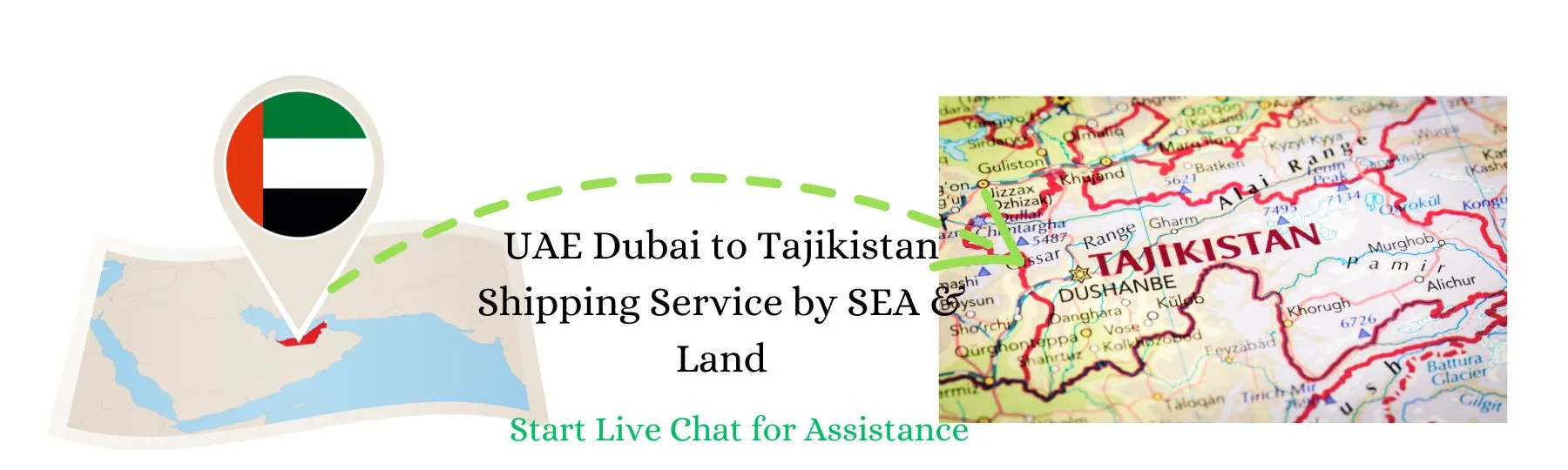
UAE Dubai to Tajikistan Shipping Service by SEA & Land
Businesses trading between the United Arab Emirates and Central Asia require a logistics solution that can manage more than one mode of transportation. Dubai to Tajikistan Shipping is a multimodal service because Tajikistan is landlocked and has no direct seaport access. Cargo must first move by sea from Dubai or Jebel Ali to a suitable regional gateway and then continue by dedicated road transport to Tajikistan.
At SLR Shipping Services LLC, we coordinate sea and land transport for full containers, dedicated trucks, vehicles, machinery, commercial cargo, and project shipments. The service can cover cargo collection in the UAE, export customs clearance, ocean transportation, transit formalities, cross-border trucking, destination customs coordination, and delivery to cities such as Dushanbe, Khujand, Bokhtar, Kulob, Tursunzoda, Istaravshan, and Panjakent.
Tajikistan’s geography makes professional route planning essential. The country is both landlocked and highly mountainous, with more than 90% of its territory dominated by mountains. Road transport handles over 94% of Tajikistan’s freight, which explains why the inland trucking stage is one of the most important parts of a Dubai-to-Tajikistan shipment.
A successful shipment therefore depends on much more than obtaining an ocean freight rate. The selected logistics provider must coordinate the vessel schedule, gateway-port handling, customs transit, truck availability, border procedures, road conditions, equipment requirements, and final delivery arrangements.
Dubai to Tajikistan Shipping at a Glance
| Service category | Available solution |
| Main origin | Dubai, Jebel Ali, Sharjah, Abu Dhabi, Ajman and other UAE locations |
| Main sea gateway | Jebel Ali Port |
| Transportation method | Combined sea and dedicated land transportation |
| Standard equipment | 20-foot, 40-foot and 40-foot high-cube containers |
| Special equipment | Open-top, flat-rack and other equipment subject to cargo approval |
| Inland movement | Dedicated truck transportation |
| Main destinations | Dushanbe, Khujand, Bokhtar, Kulob, Tursunzoda, Panjakent and other locations |
| Cargo categories | Commercial goods, vehicles, machinery, building materials, and project cargo |
| Service scope | Port-to-door, door-to-door or other agreed arrangements |
| Customs support | UAE export clearance, transit coordination, and destination-clearance support |
| Transit time | Confirmed according to vessel schedule, border conditions, and final destination |
| Freight rate | Quoted according to cargo, equipment, route and delivery location |
Why Does Dubai to Tajikistan Shipping Require Sea and Land Transportation?
Tajikistan has no coastline or commercial seaport. This means there can be no direct vessel movement from Dubai to a Tajik port.
The cargo begins its journey at Jebel Ali or another approved UAE port and travels by vessel to a gateway port in a transit country. After discharge, it is released under the correct transit procedure and transferred to a dedicated truck for the overland journey to Tajikistan.
The complete movement may involve:
- Cargo collection from the UAE supplier
- Delivery to the port or container-loading location
- UAE export customs clearance
- Container loading and vessel departure
- Arrival at the regional gateway port
- Port release and customs-transit processing
- Dedicated truck transportation through the approved corridor
- Border formalities in each transit country
- Entry into Tajikistan
- Tajikistan import customs clearance
- Final delivery to the consignee
Each stage must be connected to the next one. A delay in export documents can cause the vessel booking to be missed. A delay at the gateway port can reduce the available container free time. Incorrect transit documents can hold the truck at a border. Incomplete import permits can delay final delivery after the cargo arrives in Tajikistan.
This is why Dubai to Tajikistan Shipping should be managed as one integrated logistics operation rather than as separate sea and road bookings.
Main Dubai to Tajikistan Shipping Route
A practical route for suitable shipments is:
Dubai or Jebel Ali → Turkmenistan → Uzbekistan → Tajikistan
Under this arrangement, the container travels by sea from the UAE to the selected Iranian gateway. It then continues by dedicated road transportation through Iran, Turkmenistan, and Uzbekistan before entering Tajikistan.
The final border crossing and delivery route depend on the consignee’s destination. Cargo for Dushanbe may follow a different final road section from cargo destined for Khujand, Bokhtar, or another region.
Iran, Turkmenistan, Uzbekistan, and Tajikistan are all involved in wider regional transport-corridor initiatives. TRACECA’s current membership includes these countries, while Tajikistan is also connected to CAREC Corridors 2, 3, 5, and 6. These networks demonstrate Tajikistan’s importance in regional trade and cross-border transportation.
However, the route must always be confirmed before booking. Border procedures, truck permits, vessel schedules, cargo restrictions, insurance conditions, weather, and road availability can change. SLR Shipping therefore checks the operational route for each shipment rather than relying on a fixed assumption.
Why Jebel Ali Is Important for UAE to Tajikistan Trade
Jebel Ali Port is one of the most important logistics gateways in the Middle East. It supports more than 80 weekly shipping services and connects with over 150 ports worldwide. Its sea, road, warehousing, customs, and free-zone infrastructure make it a suitable starting point for cargo moving from Dubai to international destinations.
Dubai also functions as a major sourcing and re-export centre. Tajikistan-based importers regularly purchase products from UAE manufacturers, authorized distributors, free-zone companies, wholesalers, automotive suppliers, machinery dealers, and international brands operating from Dubai.
Cargo can originate from:
- Jebel Ali Free Zone
- Dubai Investment Park
- Dubai South
- Al Quoz
- Ras Al Khor
- Dubai Industrial City
- Sharjah industrial areas
- Ajman
- Abu Dhabi
- Ras Al Khaimah
- Other commercial and industrial locations in the UAE
When cargo is ready at a supplier’s warehouse, a truck can collect it and move it to the port, container yard, or nominated loading location. Where the shipper loads the container at its own premises, the loading plan, cargo weight, container positioning time, customs seal, and transport to Jebel Ali must be coordinated carefully.
Full-Container Dubai to Tajikistan Shipping
Our Dubai to Tajikistan Shipping service is designed for full-container movements. The shipper uses the complete container for one commercial consignment or one consignee’s cargo.
This arrangement is particularly suitable for businesses importing commercial quantities of machinery, building materials, automotive products, consumer goods, furniture, packaged products, electrical equipment, industrial components, or other high-volume shipments.
20-Foot Standard Container
A 20-foot container is commonly used for dense and heavy cargo. Typical examples include:
- Industrial machinery
- Metal products
- Spare parts
- Construction materials
- Tiles and stone products
- Packaged chemicals
- Lubricants
- Heavy tools
- Electrical components
The cargo weight must comply with the shipping line’s limit, the container’s safe payload, port restrictions, and the axle-weight limits applied during the land journey. A container that is acceptable for the sea voyage may still need adjustment if it exceeds the permitted road weight in one of the transit countries.
40-Foot Standard Container
A 40-foot standard container suits cargo that needs more floor area and internal volume but isn’t excessively tall.
Common cargo includes:
- Furniture
- Household products
- Consumer goods
- Packaged food products
- Textiles
- Retail inventory
- Electrical goods
- Automotive components
- Industrial supplies
40-Foot High-Cube Container
A 40-foot high-cube container provides additional internal height. It is often selected for bulky but comparatively lighter cargo.
This equipment may be suitable for:
- Large furniture items
- Packaging materials
- Household appliances
- Plastic products
- Insulation materials
- High-volume commercial cargo
- Large cartons
- Lightweight machinery
The shipper should provide accurate package dimensions before booking. The theoretical internal capacity of a container is not always the same as its practical loading capacity because sufficient space must remain for safe positioning, weight distribution, lashing, and cargo protection.
Dedicated Road Transportation from Dubai, UAE to Tajikistan
After the sea leg is completed, the shipment continues by dedicated road transportation.
Depending on the operational arrangement, the ocean container may continue inland on a suitable chassis, or the cargo may be transferred into an approved road vehicle. The preferred arrangement depends on container ownership, equipment availability, customs-transit rules, border requirements, cargo characteristics, and the final destination.
Dedicated trucking provides several advantages:
- The vehicle is assigned to the specific shipment
- The route can be planned around the consignee’s destination
- Cargo handling can be minimized
- Seal control can be maintained where permitted
- Delivery milestones are easier to monitor
- Special instructions can be given to the transport operator
- Oversized or heavy cargo can use suitable specialized equipment
- Final delivery can be arranged directly to a factory, warehouse, shop, or project site
For high-value cargo, the customer may request additional precautions such as approved parking locations, enhanced tracking, driver communication, route controls, or security arrangements. Availability and cost depend on the countries crossed and the level of protection required.
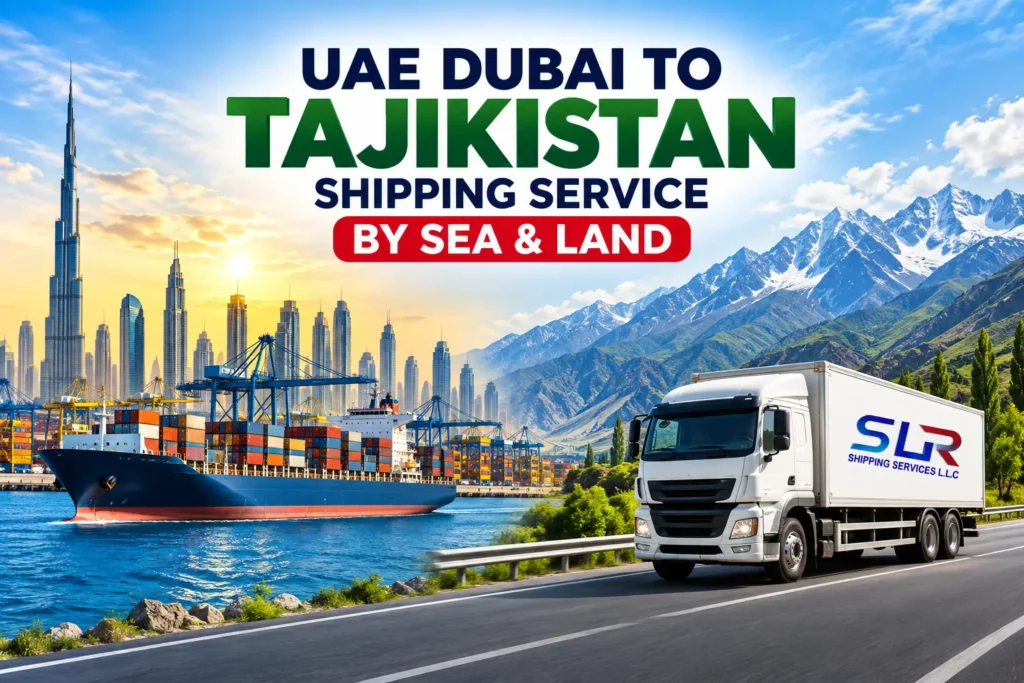
Door-to-Door Dubai to Tajikistan Shipping
Door-to-door service simplifies the shipment by placing the principal transport stages under one coordinated arrangement.
A typical door-to-door movement may include:
- Collection from the exporter’s location in the UAE
- Empty-container positioning where applicable
- Container loading
- Cargo securing and sealing
- UAE export documentation
- Export customs declaration
- Transportation to Jebel Ali
- Port handling
- Sea freight
- Gateway-port handling
- Customs-transit arrangements
- Dedicated cross-border trucking
- Tajikistan customs coordination
- Delivery to the consignee’s nominated address
The exact scope must be stated in the quotation. “Door-to-door” does not automatically mean that every charge is included.
The quotation should clearly confirm whether it includes:
- Origin pickup
- Container loading
- Export packing
- Forklift or crane service
- UAE export customs clearance
- Port charges
- Sea freight
- Transit-country charges
- Road transportation
- Border processing
- Cargo insurance
- Tajikistan customs brokerage
- Import duty and tax
- Inspection charges
- Delivery to the named city
- Unloading at destination
- Container return
- Waiting time
- Remote-area delivery
Import duties and taxes are normally based on Tajikistan’s customs classification and valuation rules. They should not be included as a fixed amount unless the product’s HS code, customs value, country of origin, and applicable regulation have been verified.
Main Tajikistan Delivery Locations
→ Dubai to Dushanbe Shipping
Dushanbe is Tajikistan’s capital and one of the most common delivery destinations for commercial cargo. Importers, distributors, retailers, contractors, and project companies use Dushanbe as a central receiving point.
Delivery can be arranged to a warehouse, industrial area, commercial premises, construction site, or other approved location.
→ Dubai to Khujand Shipping
Khujand is an important commercial centre in northern Tajikistan. The route to Khujand must be planned according to the selected Uzbek-Tajik border crossing, road conditions, equipment, and final unloading location.
→ Dubai to Bokhtar Shipping
Bokhtar is an important destination in the Khatlon region. Cargo may include agricultural equipment, construction materials, consumer products, industrial supplies, and project-related goods.
→ Dubai to Kulob Shipping
Deliveries to Kulob require confirmation of the final road section, vehicle accessibility, unloading arrangements, and consignee availability.
→ Dubai to Tursunzoda Shipping
Tursunzoda’s location west of Dushanbe makes it relevant for industrial cargo and cross-border commercial activity.
→ Dubai to Panjakent and Istaravshan Shipping
Cargo for Panjakent, Istaravshan, and other regional destinations is quoted according to the most suitable border and final-mile route.
→ Deliveries to Mountainous and Remote Areas
Tajikistan’s mountainous terrain can affect transit times, vehicle selection, road accessibility, and delivery costs. Remote destinations may require smaller delivery vehicles, route surveys, seasonal planning, or additional time.
For difficult locations, the customer should provide:
- Exact delivery coordinates
- Road-access information
- Site contact details
- Vehicle-size restrictions
- Available unloading equipment
- Working hours
- Local permit requirements
- Photos or videos of the delivery approach
Cargo Suitable for Dubai to Tajikistan Shipping
The service can be arranged for many categories of commercial and industrial cargo, subject to regulatory and carrier approval.
→ Machinery and Industrial Equipment
Dubai is a sourcing centre for new and used machinery, generators, compressors, workshop equipment, pumps, manufacturing components, and industrial spare parts.
Before booking, the shipper should provide the dimensions, gross weight, lifting points, centre of gravity, photographs, technical specifications, and packing details.
→ Automotive Cargo and Spare Parts
Automotive cargo may include:
- Engines
- Gearboxes
- Tyres
- Batteries
- Body parts
- Workshop equipment
- Replacement components
- Commercial vehicle parts
- Passenger vehicles
- Heavy vehicles
Batteries, oils, fuel, pressurized equipment, and other regulated items must be correctly declared.
→ Construction Materials
Common construction-related cargo includes:
- Tiles
- Sanitary products
- Doors
- Aluminium products
- Steel items
- Electrical materials
- Lighting equipment
- Pipes and fittings
- Insulation products
- Hardware
- Tools
Dense materials require careful container-weight planning.
→ Consumer and Retail Products
Full containers can carry household items, appliances, furniture, packaged products, textiles, electronics, and retail stock.
→ Food and Packaged Products
Food cargo may require health certificates, expiry-date information, ingredient details, labeling compliance, or temperature controls. Import requirements must be checked before departure.
→ Chemicals and Lubricants
Chemical cargo must be classified before acceptance. A current safety data sheet is required for paints, oils, lubricants, cleaning products, adhesives, and other chemical preparations.
→ Project and Oversized Cargo
Generators, construction equipment, factory components, steel structures, and oversized machinery may require open-top containers, flat-rack equipment, low-bed trailers, cranes, escorts, or route surveys.
Vehicle Shipping from Dubai to Tajikistan
Vehicles can be transported from Dubai to Tajikistan using a suitable container or another approved transport arrangement, depending on the vehicle dimensions and route availability.
Container transportation may be suitable for:
- Passenger cars
- Luxury vehicles
- Classic vehicles
- Motorcycles
- Small commercial vehicles
- Vehicles shipped together with permitted spare parts
Before booking, the shipper should provide:
- Vehicle make and model
- Manufacturing year
- Vehicle identification number
- Ownership documents
- Purchase invoice
- Export certificate
- Vehicle dimensions
- Gross weight
- Condition of the vehicle
- Photographs
- Destination city
The Tajikistan importer must verify whether the vehicle is eligible for import. Current guidance notes that Tajikistan applies restrictions to some vehicle imports, including a prohibition on vehicles manufactured before 2005. This requirement should be reconfirmed before shipment because import regulations may be amended.
Any fuel, battery, personal belongings, spare parts, or loose items inside the vehicle must comply with carrier and customs requirements.
Breakbulk, Heavy-Lift and Project Cargo
Some cargo cannot fit inside a standard closed container. In that situation, the shipment may require specialized equipment or breakbulk handling.
Possible equipment includes:
- Flat-rack containers
- Open-top containers
- Low-bed trailers
- Extendable trailers
- Multi-axle trailers
- Heavy-duty cranes
- Lifting frames
- Customized transport supports
Project cargo requires technical planning before a freight rate can be confirmed.
The shipper should submit:
- Technical drawings
- Length, width, and height
- Gross and net weight
- Lifting-point details
- Centre-of-gravity information
- Packing method
- Cargo photographs
- Loading-site conditions
- Delivery-site conditions
- Required cranes or forklifts
The road journey must also be studied. Bridge capacity, tunnel height, border-gate width, overhead cables, turning radius, mountain roads, and local restrictions can all affect the final plan.
Dubai to Tajikistan Shipping Process
1. Cargo Information Is Submitted
The customer sends the cargo description, HS code, package count, dimensions, weight, value, pickup location, destination, readiness date, and special instructions.
2. Cargo and Route Review
The logistics team checks whether the cargo is acceptable for sea and road transportation. Product restrictions, equipment requirements, border conditions, and documentation are reviewed.
3. Equipment Is Selected
The correct equipment is chosen according to cargo volume, dimensions, weight, loading method, and road limitations.
4. Freight Quotation Is Prepared
The quotation states the route, equipment, included services, exclusions, validity, payment terms, and estimated schedule.
5. Cargo Is Collected, or the Container Is Positioned
Cargo may be collected from the supplier, or an empty container may be delivered to the loading point.
6. Cargo Is Loaded and Secured
The cargo is positioned to distribute weight safely. It is blocked, braced, lashed, and protected according to its characteristics.
7. UAE Export Customs Clearance Is Completed
The export declaration and supporting documents are submitted to Dubai Customs.
Dubai Customs identifies the invoice, packing list, certificate of origin, and permits from relevant restriction authorities as standard supporting documents for a customs declaration.
8. The Container Is Delivered to Port
After customs formalities and sealing, the container is transported to the nominated terminal in accordance with the vessel’s cut-off time.
9. The Sea Journey Begins
The container is loaded on the confirmed vessel and transported to the selected gateway.
10. Gateway-Port Formalities Are Completed
The local agent coordinates discharge, port release, transit declaration, customs guarantees, and truck arrangements.
11. Dedicated Road Transportation Begins
The cargo moves through the approved countries under the relevant transit documentation.
12. The Shipment Enters Tajikistan
The driver and agent complete border formalities before the cargo proceeds to the customs office or approved clearance location.
13. Import Clearance Is Completed
The importer or appointed customs broker submits the Tajikistan import declaration, supporting documents, permits, and certificates.
14. Cargo Is Delivered
Once customs release is obtained, the truck proceeds to the agreed delivery address.
Dubai to Tajikistan Shipping Time
There is no universal transit time for Dubai to Tajikistan Shipping because the journey includes both a vessel movement and a multi-country road movement.
The total schedule is influenced by:
- Cargo readiness
- Export-document preparation
- Vessel frequency
- Port cut-off time
- Sea transit
- Gateway-port handling
- Customs-transit approval
- Truck availability
- Border queues
- Public holidays
- Customs inspection
- Weather
- Mountain-road conditions
- Final delivery city
- Import-clearance readiness
For reliable planning, the shipper should request a shipment-specific transit estimate based on the actual vessel departure and current border conditions.
A quoted transit time should be treated as an estimate rather than a guaranteed delivery date unless a separate guaranteed-service agreement has been issued. Delays caused by customs examinations, government restrictions, border closures, severe weather, or consignee documentation are generally outside the transport provider’s direct control.
Dubai to Tajikistan Shipping Cost
The cost of shipping from Dubai to Tajikistan is calculated individually. A container rate displayed without information about the cargo, delivery city, route, and inland requirements may not represent the real total cost.
The main pricing factors include the following.
→ Container Size and Type
A 20-foot standard container, 40-foot standard container, 40-foot high-cube container, flat rack, and open top have different freight and handling costs.
→ Cargo Weight
Heavy cargo may require a 20-foot container, special chassis, additional permits, or a different inland arrangement.
→ UAE Pickup Location
Collection from Jebel Ali is different from pickup in Abu Dhabi, Ras Al Khaimah, Al Ain, or several separate locations.
→ Destination in Tajikistan
The inland rate depends on whether delivery is required in Dushanbe, Khujand, Bokhtar, Kulob, Panjakent, or a remote mountain area.
→ Port and Transit Charges
Port handling, customs transit, documentation, guarantees, permits, border services, and equipment transfer can affect the total.
→ Cargo Type
Vehicles, chemicals, heavy machinery, food products, and oversized cargo require different handling and approvals.
→ Loading and Unloading Requirements
Forklifts, cranes, labour, ramps, rigging, and special lifting equipment are charged according to the operation.
→ Container Free Time
Detention or demurrage may apply when a container remains outside the agreed free period or is delayed at a port, border, customs facility, or delivery location.
→ Insurance
Insurance cost depends on the cargo value, commodity, route, packing, and coverage requested.
Information Required for a Shipping Quotation
For an accurate Dubai to Tajikistan Shipping quotation, provide:
| Information | Details required |
| Cargo description | Clear commercial name of the product |
| HS code | Customs classification, where available |
| Package count | Number of pallets, crates, cartons or units |
| Dimensions | Length × width × height of each package |
| Gross weight | Total cargo weight |
| Cargo value | Commercial invoice value and currency |
| Pickup address | Exact UAE collection location |
| Destination | City and delivery address in Tajikistan |
| Container requirement | 20-foot, 40-foot, high-cube or special equipment |
| Loading method | Warehouse loading, crane loading, or other method |
| Cargo readiness date | Confirmed date for collection |
| Special conditions | Fragile, non-stackable, hazardous, oversized or temperature-sensitive |
| Incoterm | FCA, CPT, CIP, DAP or another agreed term |
| Import permits | Details of licences or approvals already obtained |
For machinery, vehicles, chemicals, or unusual cargo, photographs and technical documents should be attached.
Required Shipping Documents
→ Commercial Invoice
The invoice should show:
- Exporter details
- Consignee details
- Invoice number and date
- Detailed product description
- Quantity
- Unit value
- Total value
- Currency
- Country of origin
- HS code
- Incoterm
- Payment terms
Descriptions such as “general cargo,” “items,” “spares,” or “materials” may be too vague for customs purposes.
→ Packing List
The packing list should identify:
- Package count
- Type of packaging
- Marks and numbers
- Contents of each package
- Net weight
- Gross weight
- Package dimensions
- Total volume
→ Certificate of Origin
The certificate of origin identifies where the goods were manufactured or substantially produced. Its information should match the invoice and cargo markings.
→ UAE Export Declaration
The UAE export declaration records the goods leaving Dubai under the correct customs procedure.
→ Bill of Lading
The bill of lading or approved sea transport document records the vessel shipment, container, shipper, consignee, and cargo details.
→ Road Consignment Documentation
The inland journey may require a CMR or another approved road consignment document, together with transit declarations and customs guarantees.
→ Import Contract
Tajikistan customs may require the commercial contract between the seller and importer as part of the import file.
→ Product-Specific Certificates
Depending on the commodity, additional documentation may include:
- Conformity certificate
- Phytosanitary certificate
- Veterinary certificate
- Health certificate
- Safety data sheet
- Dangerous-goods declaration
- Technical specification
- Manufacturer’s certificate
- Import licence
- Radio or communication-equipment approval
- Agricultural approval
- Pharmaceutical authorization
Current import guidance identifies product-specific approvals for categories including agricultural products, plants, seeds, radios, electronic devices, and high-frequency equipment.
Tajikistan Customs Clearance
The consignee should appoint a qualified destination customs broker before the cargo departs from Dubai.
The broker should confirm:
- The correct HS code
- Import eligibility
- Applicable customs duty
- Applicable taxes
- Customs value
- Required permits
- Certification requirements
- Labeling requirements
- Inspection procedures
- Customs office of clearance
- Importer registration requirements
- Payment arrangements
Tajikistan applies technical, sanitary, veterinary, phytosanitary, pharmacological, and environmental requirements to imported goods. Product certification or approval may therefore be required before customs release.
Cargo should not be dispatched merely because the UAE export documents are ready. The Tajikistan import file must also be reviewed in advance. Otherwise, the shipment may reach the destination border before the consignee is legally prepared to clear it.
TIR and Customs Transit
International road shipments may move under the TIR system where the route, carrier, customs administrations, and cargo arrangement permit its use.
TIR provides a recognized customs-transit framework for cargo moving through several countries under customs control. The eTIR system is intended to allow secure electronic exchange of transit and guarantee data between national customs systems.
Whether TIR, eTIR, or another transit procedure is used depends on the operating countries and the approved road carrier. The transport provider must confirm the applicable process for each shipment.
TIR does not remove customs responsibilities. The shipment still requires correct seals, declarations, guarantees, transport documents, and cargo information.
Packing Requirements for a Long Multimodal Journey
Cargo travelling from Dubai to Tajikistan may be exposed to vessel movement, port handling, lifting, braking, long-distance driving, vibration, temperature changes, moisture, and mountain roads.
Packing should therefore be suitable for international multimodal transportation.
→ Palletized Cargo
Cartons should be placed on strong pallets and secured using stretch film, strapping, corner protection, and suitable top protection.
→ Machinery
Machinery should be bolted or secured to a base. Moving parts should be locked, sensitive components protected, and fluids managed in accordance with carrier requirements.
→ Wooden Cases
Wooden cases should be suitable for lifting and stacking. Any wood-treatment and marking requirements should be checked before export.
→ Moisture-Sensitive Cargo
Electronics, metal parts, machinery, and other moisture-sensitive goods may require desiccants, barrier wrapping, waterproof protection, or container liners.
→ Fragile Cargo
Fragile products require rigid outer packing, internal cushioning, separation, and protection against vibration. Labels alone are not sufficient.
→ Container Securing
Cargo should be distributed evenly and prevented from moving in any direction. Blocking, bracing, lashing, airbags, timber supports, and anti-slip materials may be required.
Cargo Insurance
Cargo insurance is strongly recommended for Dubai to Tajikistan Shipping because the journey involves a sea leg, port handling, customs transit, a long road journey, several borders, and final delivery.
The insurance policy should be checked for:
- Sea transportation
- Road transportation
- Port handling
- Transshipment
- Theft
- Collision
- Water damage
- Fire
- General average
- Storage during transit
- War-risk exclusions
- Sanctioned territories
- Remote-area delivery
Carrier liability is not the same as cargo insurance. Transport providers may have limited liability under their contract or the applicable transport convention.
Incoterms for UAE Dubai to Tajikistan Shipping Transactions
The buyer and seller should agree on a clear Incoterm and named location.
Common options include:
→ FCA — Free Carrier
The seller delivers the goods to the appointed carrier at the agreed UAE location and completes export clearance.
→ CPT — Carriage Paid To
The seller pays for transportation to the named destination, but risk transfers when the cargo is handed to the carrier.
→ CIP — Carriage and Insurance Paid To
The seller arranges carriage and insurance to the named destination under the rule’s requirements.
→ DAP — Delivered at Place
The seller arranges transport to the agreed place in Tajikistan. Import clearance and duties normally remain the buyer’s responsibility.
The contract should state the location precisely, for example:
DAP Dushanbe, Tajikistan, Incoterms 2020
A vague term such as “delivered Tajikistan” can cause disagreement about customs charges, unloading, taxes, and remote-area delivery.
Why Choose SLR Shipping Services LLC for Dubai to Tajikistan Shipping/Land Transportation?
SLR Shipping Services LLC provides a coordinated approach to Dubai to Tajikistan Shipping by managing the sea and land portions as one connected operation.
Our service can include:
- UAE cargo pickup
- Full-container booking
- 20-foot and 40-foot container options
- Special-equipment planning
- UAE export customs coordination
- Jebel Ali port handling
- Sea transportation to the regional gateway
- Transit-document coordination
- Dedicated cross-border trucking
- Heavy and oversized cargo planning
- Vehicle transportation
- Destination customs coordination
- Delivery to major Tajikistan cities
- Shipment milestone updates
Our team reviews the cargo, route, documents, and destination before confirming a booking. This reduces the risk of sending cargo without the correct equipment, permits, customs documents, or delivery plan.
Every shipment is quoted individually because equipment availability, vessel schedules, transit requirements, border conditions, and delivery costs can change.

Dubai to Tajikistan Shipping FAQs
1. Can cargo be shipped directly by sea from Dubai to Tajikistan?
No. Tajikistan is landlocked and does not have a seaport. The cargo travels by sea from Dubai or Jebel Ali to a regional gateway and then continues to Tajikistan by dedicated road transport.
2. What is the main Dubai to Tajikistan Shipping route?
A practical route for suitable shipments is Dubai or Jebel Ali to an Iranian gateway by sea, followed by dedicated trucking through Iran, Turkmenistan, and Uzbekistan to Tajikistan. The exact route is confirmed according to current operational conditions.
3. Do you provide full-container shipping from Dubai to Tajikistan?
Yes. The service can be arranged using 20-foot, 40-foot, or 40-foot high-cube containers. Open-top and flat-rack equipment may also be considered for suitable cargo.
4. Do you provide dedicated truck transportation to Tajikistan?
Yes. After completion of the sea leg and transit formalities, the cargo continues by a truck assigned to the shipment.
5. How long does Dubai to Tajikistan Shipping take?
The transit time depends on the vessel schedule, gateway-port handling, customs-transit procedures, truck availability, border waiting time, weather, and the final delivery city. A current shipment-specific estimate should be requested before booking.
6. How much does it cost to ship a container from Dubai to Tajikistan?
The cost depends on container size, cargo weight, UAE pickup point, destination city, route, port charges, transit fees, customs requirements, and equipment availability. Complete cargo details are required for an accurate quotation.
7. Can you deliver a container from Dubai to Dushanbe?
Yes. Delivery can be arranged to Dushanbe after completion of sea freight, customs transit, Tajikistan import clearance, and final road transportation.
8. Can cargo be delivered to Khujand?
Yes. Dubai-to-Khujand shipping can be arranged, subject to the selected border route, cargo acceptance, road conditions, customs clearance, and delivery access.
9. Do you offer door-to-door shipping to Tajikistan?
Door-to-door service can be arranged from the UAE pickup location to the consignee’s nominated address. The quotation will explain whether import customs clearance, duty, tax, unloading, and remote delivery are included.
10. What documents are required to export cargo from Dubai?
The standard documents normally include a commercial invoice, packing list, certificate of origin, UAE export declaration, and bill of lading. Restricted products require additional permits.
11. What documents are required for Tajikistan customs clearance?
The importer may require the commercial contract, invoice, packing list, certificate of origin, shipping document, road document, customs declaration, and product-specific permits or certificates.
12. Can vehicles be shipped from Dubai to Tajikistan?
Yes. Passenger cars, motorcycles, and some commercial vehicles can be shipped using suitable equipment, subject to export documentation, carrier approval, and Tajikistan import eligibility.
13. Can heavy machinery be shipped to Tajikistan?
Yes. Machinery can move in a standard container, open top, flat rack, or specialized project-cargo arrangement depending on its dimensions, weight, lifting points, and delivery route.
14. Can dangerous goods be transported?
Some dangerous goods may be accepted after approval from the vessel operator, ports, road carrier, and transit authorities. The shipper must provide the UN number, hazard class, proper shipping name, packing group, and safety data sheet.
15. Is cargo insurance necessary?
Insurance is strongly recommended. The cargo passes through several transport stages and countries, and standard carrier liability may not cover the full commercial value.
16. Can you collect cargo outside Dubai?
Yes. Pickup may be arranged from Sharjah, Ajman, Abu Dhabi, Ras Al Khaimah, Fujairah, Umm Al Quwain, Al Ain, and other UAE locations, subject to truck availability and the quotation.
17. Can construction materials be shipped to Tajikistan?
Yes. Tiles, sanitary products, steel items, aluminium products, pipes, electrical materials, doors, tools, and other building products can be transported, subject to container payload and import requirements.
18. Can food products be shipped from Dubai to Tajikistan?
Suitable packaged food products may be shipped when all health, labeling, shelf-life, certification, and customs requirements are satisfied.
19. Who pays customs duty in Tajikistan?
Responsibility depends on the sales contract and agreed Incoterm. Under DAP, the buyer usually completes import clearance and pays applicable duties and taxes.
20. How do I request a Dubai to Tajikistan Shipping quotation?
Provide the cargo description, HS code, number of packages, dimensions, total weight, cargo value, UAE pickup location, Tajikistan destination, container requirement, and cargo readiness date.
21. Can the container remain sealed during the land journey?
The container may continue under customs seal, depending on equipment availability, customs procedure, container ownership, transit-country rules, and delivery arrangements. This must be confirmed for each shipment.
22. Can you arrange delivery to a project site?
Yes, subject to road access, site conditions, permits, vehicle restrictions, and the availability of suitable unloading equipment. Site coordinates and photographs should be provided before quotation.
23. What causes delays during Dubai to Tajikistan Shipping?
Common causes include incomplete documents, missed vessel cut-offs, port congestion, customs inspection, transit-permit delays, border queues, public holidays, weather, road restrictions, and consignee-clearance issues.
24. How can shipping delays be reduced?
Prepare the invoice, packing list, certificate of origin, permits, HS code, and destination customs file before cargo collection. The consignee should appoint its Tajikistan customs broker before the vessel departs.
25. What is the best container size for shipping to Tajikistan?
A 20-foot container is usually suitable for dense, heavy cargo. A 40-foot or high-cube container is usually more appropriate for bulky, lighter cargo. The correct option depends on actual dimensions, weight, and loading method.
Dubai to Tajikistan Shipping requires professional coordination of ocean freight, port operations, customs transit, dedicated road transportation, border procedures, and final delivery.
Because Tajikistan is landlocked, the journey cannot be completed by sea alone. Cargo must move from Dubai or Jebel Ali to a suitable gateway port and then continue overland through an approved regional corridor.
Full-container shipping is suitable for commercial cargo, machinery, vehicles, building materials, industrial goods, and project shipments. The correct container, truck, route, documentation, and customs procedure must be selected according to the cargo and delivery city.
SLR Shipping Services LLC can coordinate the complete movement from the UAE to Dushanbe, Khujand, Bokhtar, Kulob, Tursunzoda, Panjakent, and other Tajikistan destinations. Every shipment is planned and quoted individually according to cargo specifications, live vessel availability, transit requirements, border conditions, and final-delivery arrangements.
Our team can review your requirements and recommend a suitable shipping solution.